Coffee Maker Buying Guide: 5 Types Compared & How to Choose
Compare single-serve, drip, espresso, French press and cold brew coffee makers. Explore their differences, features, limitations and recommended products to choose the right coffee maker for your home.
Coffee Maker Buying Guide: 5 Types Compared & How to Choose
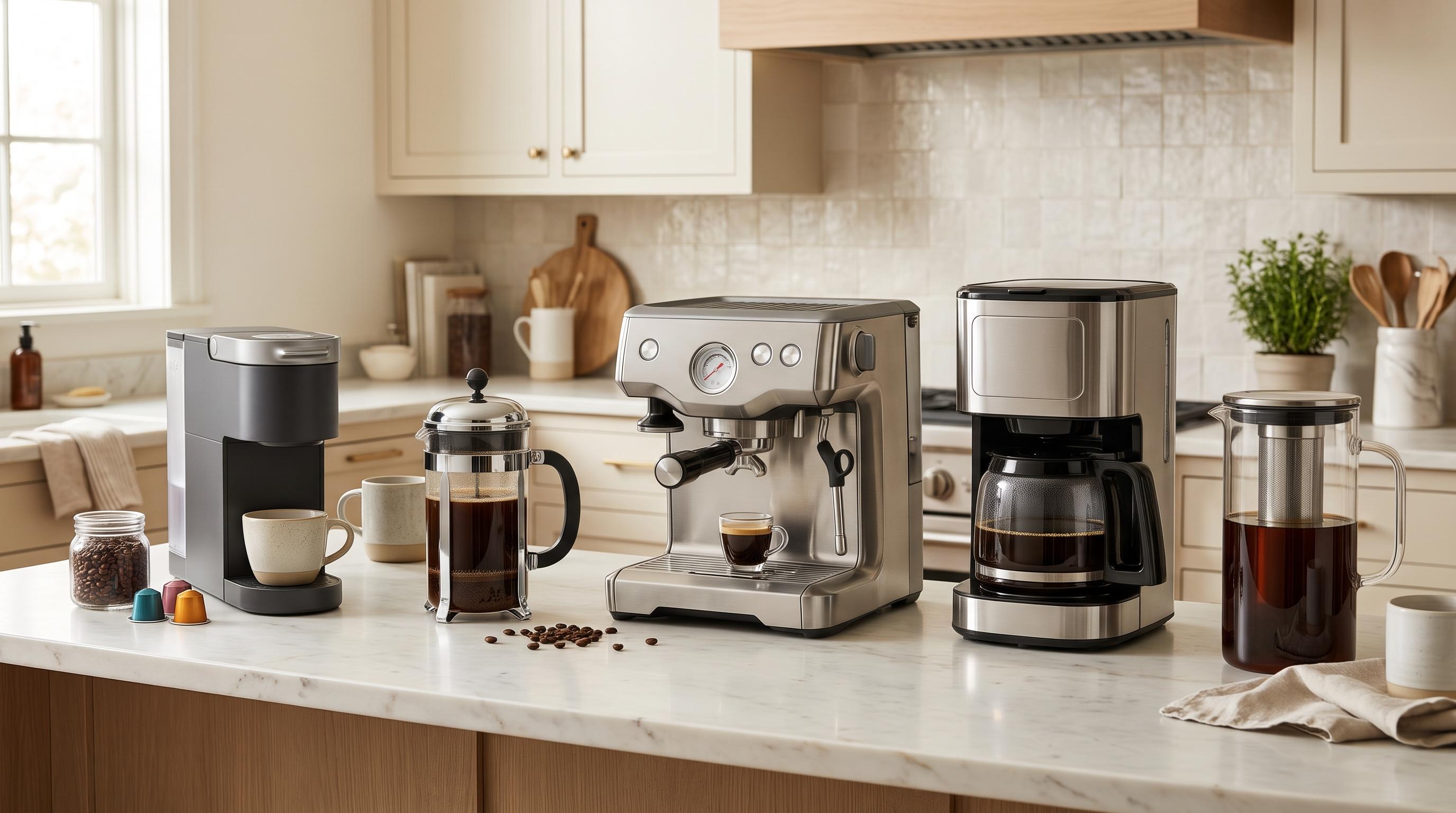
Choosing a coffee maker isn't just about buying the most popular machine. The right choice depends on how you enjoy your coffee, how many cups you prepare, how much time you have, and how much space is available in your kitchen.
Some coffee makers are designed for quick, individual servings, while others prepare a full pot for the family. Espresso machines offer more control over café-style drinks, and French presses and cold brew makers provide simpler manual brewing options.
In this guide, we'll compare five popular types of coffee makers, explain their differences, highlight what to consider before buying, and explore nine coffee makers that serve different household needs and brewing preferences.
How We Selected These Coffee Makers
We selected these coffee makers by comparing their published manufacturer specifications, brewing capacity, features, materials, maintenance requirements and suitability for different household needs. We also reviewed product listing information and customer feedback to understand what buyers should consider before purchasing.
This is a research-based buying guide, not a hands-on test of every machine. We aim to explain the differences, advantages and limitations of each option so you can make an informed buying decision.
1. Single-Serve Coffee Makers
Single-serve coffee makers are designed to prepare one cup at a time. Most pod-based machines use pre-portioned coffee pods, making them convenient for people who want coffee quickly without measuring coffee grounds or preparing a full pot.
They're particularly useful for individuals, smaller households, offices, and people who prefer different coffee flavors throughout the day.
What to consider before buying a single-serve coffee maker
- Brewing sizes: Check whether the machine supports your preferred cup sizes.
- Water reservoir: A larger reservoir means fewer refills.
- Pod compatibility: Check which coffee pods the machine accepts and whether reusable filters are available.
- Brewing options: Features such as stronger coffee settings and iced coffee options may be useful.
- Operating costs: Calculate the ongoing cost of coffee pods, not just the initial machine price.
Recommended single-serve coffee makers
Keurig K-Elite Single Serve Coffee Maker
The Keurig K-Elite is a feature-rich option for people who want flexibility in their everyday coffee routine.
Its main features include:
- Five brewing sizes: 4, 6, 8, 10 and 12 oz.
- Large 75 oz removable water reservoir.
- Strong Brew setting for a bolder cup.
- Iced coffee setting for brewing hot coffee over ice.
- Hot water on demand.
- Adjustable brewing temperature.
It can be a suitable choice for households that frequently prepare individual drinks and want more brewing options.
Consider before buying: Its larger reservoir and additional settings may be unnecessary if you only need a basic single-cup machine. Coffee pods also create an ongoing expense.
Keurig K-Express Single Serve Coffee Maker
The K-Express is a simpler alternative for people who want convenient single-cup brewing without paying for as many additional features.
Its main features include:
- Three brewing sizes: 8, 10 and 12 oz.
- 42 oz removable water reservoir.
- Strong Brew setting.
- Compact countertop design.
- Compatibility with K-Cup coffee pods.
It is worth considering for smaller households and people who primarily want a straightforward pod-based coffee machine.
Consider before buying: It has fewer customization options and a smaller reservoir than the K-Elite.
2. Drip Coffee Makers
Drip coffee makers are designed to prepare several servings of regular coffee in one brewing cycle.
They work by heating water and allowing it to flow through ground coffee held in a filter basket. The brewed coffee then collects in a glass or thermal carafe.
This type is particularly useful for families, couples, shared kitchens, and people who drink several cups throughout the morning.
What to consider before buying a drip coffee maker
- Carafe capacity: Choose a capacity that matches the number of people drinking coffee.
- Programmable brewing: A timer can make morning preparation more convenient.
- Brew strength: Some machines offer regular and bold settings.
- Filter type: Check whether the machine uses paper filters or includes a reusable filter.
- Cleaning: Removable components and descaling reminders can make maintenance easier.
- Carafe type: Glass carafes are easy to see through, while thermal carafes can help retain heat without relying on a warming plate.
Remember that coffee maker manufacturers may measure a cup differently from a standard household mug. Check the stated capacity before purchasing.
Recommended drip coffee maker
Cuisinart DCC-3200NAS PerfecTemp 14-Cup Programmable Coffee Maker
The Cuisinart PerfecTemp is designed for households that want to prepare multiple servings of coffee without brewing each cup individually.
Its main features include:
- 14-cup glass carafe.
- 24-hour programmable brewing.
- Regular and Bold brew strength settings.
- 1–4 cup brewing option.
- Brew Pause feature.
- Self-cleaning function.
- Adjustable automatic shut-off.
It may suit families and people who prefer to prepare coffee in larger batches.
Consider before buying: Its larger carafe and countertop footprint may not be ideal for someone who usually makes just one cup. Check the available counter space and your household's actual coffee consumption.
3. Espresso Machines
Espresso machines use pressure to force hot water through finely ground, compacted coffee.
They are useful for people who enjoy espresso shots and café-style beverages such as lattes, cappuccinos, Americanos, and macchiatos.
Unlike basic single-serve machines, manual and semi-automatic espresso machines require more involvement. Grinding, dosing, tamping, extraction, and milk frothing can all affect the final drink.
What to consider before buying an espresso machine
- Built-in grinder: A grinder can reduce the need to purchase separate equipment.
- Portafilter size: Check accessory compatibility before buying additional equipment.
- Temperature control: Stable brewing temperature helps produce more consistent extractions.
- Milk frother: A steam wand is useful for preparing milk-based drinks.
- Water reservoir: Consider how frequently you'll need to refill it.
- Cleaning and descaling: Espresso machines require regular maintenance.
- Learning curve: More manual control usually requires additional practice.
Recommended espresso machines
CASABREWS CM5418 Espresso Machine
The CASABREWS CM5418 is a compact entry-level espresso machine for people interested in preparing espresso and milk-based drinks at home.
Its published features include:
- 20-bar rated pump pressure.
- PID temperature control.
- Low-pressure pre-infusion.
- Built-in pressure gauge.
- Single and double espresso settings.
- Manual milk-frothing steam wand.
- 34 oz removable water reservoir.
- 51 mm portafilter.
It provides a combination of brewing controls and milk-frothing functionality without requiring an integrated grinder.
Consider before buying: It does not include a built-in coffee grinder. You'll need suitable ground coffee or a separate espresso grinder. The manual workflow also takes practice.
A higher advertised pump-pressure number does not automatically mean better espresso. Grind consistency, coffee dose, extraction and temperature control also matter.
Breville Barista Express BES870XL
The Breville Barista Express is a more involved home espresso option for people who want greater control over grinding and preparing their coffee.
Its main features include:
- Integrated conical burr grinder.
- 16 grind settings.
- Integrated grinding and dosing.
- 54 mm stainless-steel portafilter.
- PID temperature control.
- Low-pressure pre-infusion.
- Manual steam wand for milk texturing.
- Single and double shot options.
Unlike the CASABREWS CM5418, the Barista Express includes an integrated grinder, which brings more of the espresso preparation process into one machine.
Consider before buying: Its higher price, larger countertop footprint and more involved preparation process may not suit someone who simply wants a quick cup of coffee.
4. French Press Coffee Makers
A French press is a manual coffee brewing device that uses immersion rather than an automatic brewing cycle.
Ground coffee is placed inside a carafe, hot water is added, and the coffee is allowed to steep. A mesh filter attached to the plunger is then pressed down to separate most of the grounds from the brewed coffee.
French presses are useful for people who prefer a simple brewing method without electrical components, pods, or complicated controls.
What to consider before buying a French press
- Capacity: Choose a size suitable for your usual number of servings.
- Carafe material: Common options include glass and stainless steel.
- Insulation: Double-wall stainless-steel designs can retain heat longer.
- Filtration: Check the mesh filter construction and availability of replacement filters.
- Cleaning: The filter assembly should be easy to disassemble and clean.
- Coffee grind: Coarsely ground coffee is generally more suitable for French press brewing than fine espresso grounds.
Recommended French presses
Utopia Kitchen 34 oz Stainless Steel French Press
This Utopia Kitchen French press is a suitable option for people who prefer a stainless-steel design.
Its listed features include:
- 34 oz capacity.
- 304-grade stainless-steel construction.
- Double-wall insulated design.
- Four-level filtration system.
- Additional replacement filters.
- Reusable manual brewing system.
Its stainless-steel construction makes it worth considering for people who prefer an alternative to a traditional glass carafe.
Consider before buying: Check its dimensions and capacity against your available kitchen space. Also follow the manufacturer's cleaning instructions to maintain the filtration assembly.
Veken 34 oz French Press
The Veken French press is another option for people looking for a larger manual coffee brewing device.
Its listed features include:
- Approximately 34 oz / 1-liter capacity.
- Reusable filtration system.
- Manual plunger operation.
- Removable brewing components.
- Design intended for home and everyday use.
It provides an alternative to an insulated stainless-steel French press for people who prefer a different carafe style.
Consider before buying: Check the exact glass, metal and plastic components of the selected variant, along with its cleaning instructions and included accessories.
5. Cold Brew Coffee Makers
Cold brew coffee makers are designed to prepare coffee using cold or room-temperature water rather than the traditional hot brewing process.
Ground coffee is placed inside a filter or brewing container, water is added, and the mixture is left to steep for an extended period.
The result is a coffee concentrate or ready-to-drink cold brew, depending on the coffee-to-water ratio used.
Cold brew makers are useful for people who enjoy iced coffee and prefer preparing a larger quantity in advance.
What to consider before buying a cold brew maker
- Container capacity: Check how much cold brew you want to prepare at once.
- Filter material: Reusable stainless-steel filters are common.
- Lid and seal: A secure lid helps prevent spills and unwanted odors.
- Pouring design: A comfortable handle and practical pouring spout make serving easier.
- Cleaning: Wide-mouth containers and removable filters can simplify cleaning.
- Storage: Consider whether the container fits comfortably inside your refrigerator.
Recommended cold brew makers
County Line Kitchen 64 oz Cold Brew Coffee Maker
The County Line Kitchen cold brew maker is a large glass pitcher-style option for people who want to prepare cold brew at home.
Its listed features include:
- 64 oz / 2-quart glass mason jar.
- Reusable stainless-steel filter.
- Wide-mouth container.
- Handle for carrying and pouring.
- Leak-resistant lid design.
Its large capacity can be useful for preparing multiple servings rather than making one drink at a time.
Consider before buying: Glass requires careful handling. Follow the manufacturer's temperature guidance and avoid sudden temperature changes.
QHH 64 oz Cold Brew Coffee Maker
The QHH cold brew maker is another pitcher-style option with a large brewing capacity.
Its listed features include:
- 64 oz glass container.
- Reusable stainless-steel filter.
- Pouring spout and handle.
- Lid designed for storage.
- Cleaning brush included.
It is worth considering as a lower-cost alternative for people who want a straightforward cold brew pitcher.
Consider before buying: Check the container and lid specifications carefully. This model's instructions warn against pouring boiling water directly into the glass container and specify a maximum operating temperature of 140°F (60°C).
6. Coffee Maker Comparison: Which Type Should You Choose?
The following table summarizes the main differences between the five coffee maker types.
| Coffee maker type | Best suited for | Main advantage | Main consideration |
|---|---|---|---|
| Single-serve | Individuals and quick drinks | Convenient individual brewing | Ongoing pod costs |
| Drip | Families and multiple servings | Brews a larger batch | Counter space and carafe capacity |
| Espresso | Espresso and milk-based drinks | More control over preparation | Learning curve and maintenance |
| French press | Manual coffee brewing | Simple equipment and brewing process | Manual preparation and filter cleaning |
| Cold brew | Iced coffee lovers | Prepares coffee in larger batches | Requires advance preparation |
7. What Should You Consider Before Buying a Coffee Maker?
Before selecting a machine, think about how you actually drink coffee. A popular product is not necessarily the right product for your household.
1. How much coffee do you prepare?
If you usually drink one cup in the morning, a single-serve brewer may be sufficient.
If multiple family members drink coffee, a drip coffee maker with a larger carafe may be more practical.
2. How much time do you want to spend preparing coffee?
Pod-based machines generally require less preparation than manual espresso machines.
French presses also require manual measuring, steeping, and filtering, while cold brew requires advance preparation.
3. What type of coffee do you enjoy?
Consider whether you regularly drink:
- Regular brewed coffee.
- Espresso shots.
- Cappuccinos and lattes.
- French press coffee.
- Iced coffee and cold brew.
Choose a coffee maker that supports your actual preferences instead of paying for features you are unlikely to use.
4. What is your budget?
The initial purchase price is only one part of the cost.
Also consider:
- Coffee pods or ground coffee.
- Replacement filters.
- Cleaning and descaling products.
- Grinder and milk-frothing accessories.
- Replacement carafes and other parts.
5. How much kitchen space do you have?
Measure the available countertop area before buying a larger appliance.
Remember to account for access to the water reservoir, filter basket, lid, and other removable components.
6. How easy is the coffee maker to maintain?
Every coffee maker needs cleaning.
Check the manufacturer's cleaning instructions, filter replacement options, descaling recommendations, and availability of replacement parts.
8. Frequently Asked Questions
Which type of coffee maker is best for everyday home use?
It depends on your routine. Single-serve machines are convenient for individual cups, drip coffee makers work well for multiple servings, and French presses offer a simple manual brewing method.
What is the difference between a single-serve and drip coffee maker?
A single-serve machine prepares one serving at a time, often using coffee pods. A conventional drip coffee maker filters hot water through ground coffee and collects several servings in a carafe.
Is an espresso machine suitable for beginners?
Some entry-level machines offer straightforward controls, but espresso preparation still requires practice. Consider the availability of a grinder, simple controls, cleaning requirements, and milk-frothing features before buying.
Is a French press better than a drip coffee maker?
Neither is universally better. A French press uses immersion brewing and manual filtration, while a drip coffee maker automatically prepares coffee using heated water and a filter.
What is the difference between iced coffee and cold brew?
Traditional iced coffee is generally brewed hot and then cooled or poured over ice. Cold brew is prepared by steeping coffee grounds in cold or room-temperature water for an extended period.
How often should you clean a coffee maker?
Clean removable components regularly according to the manufacturer's instructions. Coffee residue can affect flavor, while mineral buildup may require periodic descaling. The recommended schedule varies by machine and water hardness.
Should I buy a coffee maker during Black Friday sales?
Seasonal sales can offer opportunities to save money, but compare the current price with the product's normal price history before purchasing. Also check the exact model, seller, warranty, and return policy rather than choosing a machine based only on its advertised discount.
Final Thoughts
The right coffee maker is the one that matches your preferred brewing method, daily routine, household size, and maintenance expectations.
For convenient individual cups, consider a single-serve machine. For preparing coffee for several people, a programmable drip coffee maker may be more practical. If you enjoy café-style beverages, an espresso machine offers more control, while French presses and cold brew pitchers provide alternatives for manual coffee preparation.
Compare the features, understand the limitations, and choose a machine that fits the way you actually enjoy coffee.
Take your time before purchasing. A good coffee maker should make your everyday coffee routine easier, more enjoyable, and better suited to your kitchen.